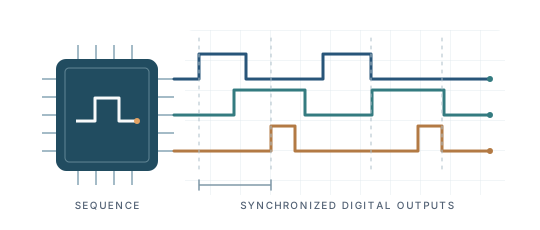
Digital timing & control
PulsePins
PulsePins turns a Terasic DE10-Nano into a laboratory pulse sequencer using our FPGA firmware and software. Program pulse sequences and triggers, coordinate digital outputs, and keep instruments synchronized.
FPGA firmware and software for quantum experiments
Jožef Stefan Institute · Ljubljana
Control Read-out Feedback
Explore the projects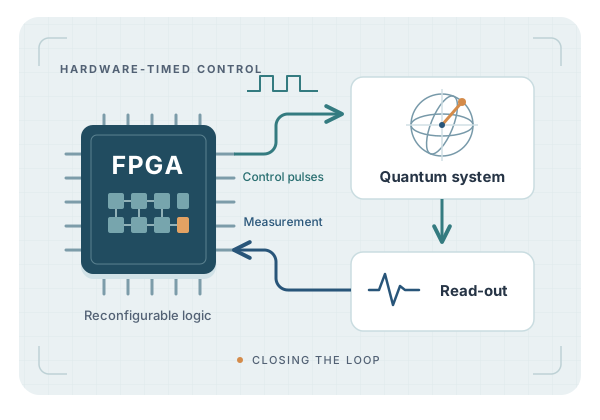
On the lab bench
One of the most versatile tools on a physics lab bench is the field-programmable gate array (FPGA), a chip whose internal logic can be reconfigured to form a digital circuit of our own design. The same board can serve as a signal generator, process several detector signals in parallel, or stabilize an experiment through feedback. We can also combine these functions in a single instrument and change how they work together as the experiment evolves.
This flexibility makes FPGAs exceptionally useful in a quantum physics lab, where control and read-out often go hand in hand. An FPGA can shape the pulses that manipulate a quantum system, process the signals that reveal its state, and use a measurement outcome to choose the next pulse. With the timing set in hardware, the delay between measurement and action can be both short and reproducible. The projects below give a glimpse of the FPGA-based instruments we are developing at the Jožef Stefan Institute.
Explore the instruments
Timing, signals, and the connections between them.
We develop FPGA firmware and software that turn commercially available boards into instruments for quantum-physics experiments. The boards themselves—including the Red Pitaya STEMlab 125-14—are made by their respective manufacturers.
Digital timing & control
PulsePins turns a Terasic DE10-Nano into a laboratory pulse sequencer using our FPGA firmware and software. Program pulse sequences and triggers, coordinate digital outputs, and keep instruments synchronized.
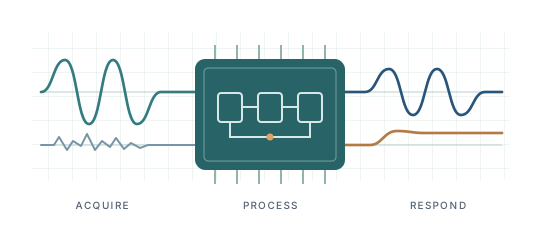
Signal generation, read-out & feedback
Our FPGA firmware and accompanying software turn a Red Pitaya STEMlab 125-14 into a versatile set of laboratory instruments: waveform generators, lock-in amplifiers, feedback controllers, time taggers, and photon counters.
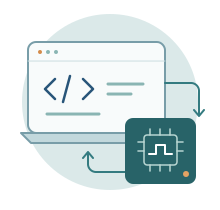
Learn by building
Skills for the quantum lab
We offer hands-on training and internships through CC Chip.si, the Slovenian competence centre for chips and semiconductor technologies.
Work with us on digital circuit design and verification, including FPGA-based laboratory control, and using hardware-in-the-loop AI development and testing workflows for building custom control systems.