Kondov pojav / Kondo effect
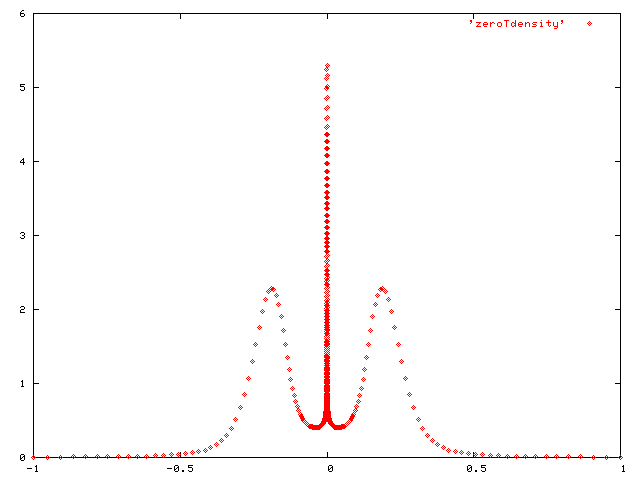
Spektralna gostota magnetne nečistoče, opisane z Andersonovim modelom, pri temperaturi T = 0. Izračun je bil opravljen z metodo numerične renormalizacijske grupe (NRG). Pri Fermijevi energiji (e = 0) je prisotna zelo ostra Kondova resonanca. Ta je posledica večdelčnih interakcij in singletnega osnovnega stanja. Eksperimentalno jo lahko zaznamo kot vrh v krivuljah diferencialne prevodnosti (dI/dV) v odvisnosti od napetosti V pri meritvah toka skozi kvantne pike.
Zero-temperature spectral density of a magnetic impurity described by the single-impurity Anderson model (SIAM). The plot was produced using a numerical renormalization group (NRG) calculation. A very narrow Kondo resonance appears at the Fermi level (e = 0). It arises from many-particle interactions and the singlet ground state. In transport measurements through quantum dots, it can be detected as a peak in the differential conductance (dI/dV) as a function of voltage V.
Kondov pojav
Elektronsko strukturo kristalnih snovi navadno opišemo z odvisnostjo energij ω enodelčnih stanj od kristalne gibalne količine k. Dodatne težave prinese Coulombska interakcija med pari elektronov. Če so korelacije med elektroni šibke, jih lahko približno upoštevamo s približkom povprečnega polja. V nasprotnem primeru imamo opravka z močno koreliranim sistemom, katerega obnašanje je bolj kompleksno. Močne korelacije lahko povzročijo atomi z delno zasedenimi 3d (prehodne kovine) in 4f orbitalami (lantanidi). Če imamo v sicer čisti navadni kovini (na primer bakru) majhno koncentracijo magnetnih nečistoč (na primer kobalta), pride pod neko temperaturo do novega večdelčnega pojava, imenovanega po japonskem fiziku Junu Kondu. Prevodniški elektroni okoli vsakega magnetnega atoma ustvarijo oblak, ki senči vrtilno količino nečistoče. Zaradi senčenja pride do merljivih pojavov, na primer do minimuma upornosti v odvisnosti od temperature.
Ta pojav so opazili tudi v kvantnih pikah z lihim številom elektronov. Prevodnost takšnih kvantnih pik v režimu Coulombske blokade pod neko temperaturo nenadoma naraste in v nekaterih primerih doseže cel kvant prevodnosti.
Do Kondovega pojava pride tudi pri adsorbiranih magnetnih atomih na površinah kovin. Ker lahko s konico vrstičnega tunelskega mikroskopa (STM) atome na površini premikamo in gradimo različne nanostrukture, je tako mogoče raziskati, kaj se zgodi s Kondovim pojavom, če je v bližini več magnetnih nečistoč. Magnetni atomi namreč vplivajo drug na drugega, saj Kondov pojav tekmuje z magnetno sklopitvijo med atomi. Ker lahko s STM merimo lokalno gostoto elektronskih stanj, je mogoče z istim instrumentom določati parametre poskusa (medsebojne lege atomov) in opravljati spektroskopske meritve.
Kondo effect
The electronic structure of crystalline matter is usually described using dispersion relations: the energy ω of one-particle states as a function of the crystal momentum k. The Coulomb interaction between electrons introduces additional complexity. If the correlations are weak, they can be approximated using a mean-field treatment. Otherwise, the system is strongly correlated and its behaviour is more complex. Strong correlations can arise from atoms with partially occupied 3d orbitals (transition metals) or 4f orbitals (lanthanides). In an otherwise pure metal, such as copper, a small concentration of magnetic impurities, such as cobalt, gives rise below a characteristic temperature to a many-particle effect named after the Japanese physicist Jun Kondo. Conduction-band electrons form a cloud that screens the impurity's spin. This screening leads to measurable effects, including a minimum in the resistance as a function of temperature.
The Kondo effect has also been observed in quantum dots with an odd number of electrons. In the Coulomb-blockade regime, their conductance increases below a certain temperature. In some cases the conductance reaches a full conductance quantum.
Kondo physics has also been observed in magnetic atoms adsorbed on metal surfaces. A scanning tunneling microscope (STM) can be used to move atoms on a surface and build various nanostructures. We can therefore explore how the Kondo effect changes when several magnetic atoms are close to one another. Exchange coupling between their spins competes with Kondo screening. Since STM can measure the local density of electronic states, the same instrument can be used both to set the parameters of the experiment (positions of individual atoms) and perform measurements.